

How To Find Volume Rotated About Y Axis
6. Applications of Integration
6.3 Volumes of Revolution: Cylindrical Shells
Learning Objectives
- Calculate the volume of a solid of revolution by using the method of cylindrical shells.
- Compare the different methods for calculating a volume of revolution.
In this section, we examine the method of cylindrical shells, the final method for finding the volume of a solid of revolution. We can use this method on the same kinds of solids as the disk method or the washer method; however, with the disk and washer methods, we integrate along the coordinate axis parallel to the axis of revolution. With the method of cylindrical shells, we integrate along the coordinate axis perpendicular to the axis of revolution. The ability to choose which variable of integration we want to use can be a significant advantage with more complicated functions. Also, the specific geometry of the solid sometimes makes the method of using cylindrical shells more appealing than using the washer method. In the last part of this section, we review all the methods for finding volume that we have studied and lay out some guidelines to help you determine which method to use in a given situation.
The Method of Cylindrical Shells
Again, we are working with a solid of revolution. As before, we define a region  bounded above by the graph of a function
  below by the
  and on the left and right by the lines
  and
and  respectively, as shown in (Figure)(a). We then revolve this region around the
  -axis, as shown in (Figure)(b). Note that this is different from what we have done before. Previously, regions defined in terms of functions of
  were revolved around the
  or a line parallel to it.
As we have done many times before, partition the interval ![\left[a,b\right]](https://opentextbc.ca/calculusv1openstax/wp-content/ql-cache/quicklatex.com-4d1bbb7cb60d0c18f08662cd16f84814_l3.png "Rendered by QuickLaTeX.com") using a regular partition,
using a regular partition,  and, for
  choose a point
 ![{x}_{i}^{*}\in \left[{x}_{i-1},{x}_{i}\right].](https://opentextbc.ca/calculusv1openstax/wp-content/ql-cache/quicklatex.com-5697aabbe5ae16e98938ec218d064c6d_l3.png "Rendered by QuickLaTeX.com") Then, construct a rectangle over the interval
Then, construct a rectangle over the interval ![\left[{x}_{i-1},{x}_{i}\right]](https://opentextbc.ca/calculusv1openstax/wp-content/ql-cache/quicklatex.com-635aab70130434308c04a5b3f8db45d2_l3.png "Rendered by QuickLaTeX.com") of height
of height  and width
  A representative rectangle is shown in (Figure)(a). When that rectangle is revolved around the -axis, instead of a disk or a washer, we get a cylindrical shell, as shown in the following figure.
To calculate the volume of this shell, consider (Figure).
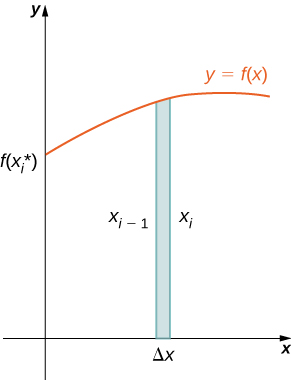
The shell is a cylinder, so its volume is the cross-sectional area multiplied by the height of the cylinder. The cross-sections are annuli (ring-shaped regions—essentially, circles with a hole in the center), with outer radius  and inner radius
  Thus, the cross-sectional area is
  The height of the cylinder is
  Then the volume of the shell is
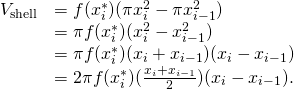
Note that  so we have

Furthermore,  is both the midpoint of the interval and the average radius of the shell, and we can approximate this by
  We then have

Another way to think of this is to think of making a vertical cut in the shell and then opening it up to form a flat plate ((Figure)).
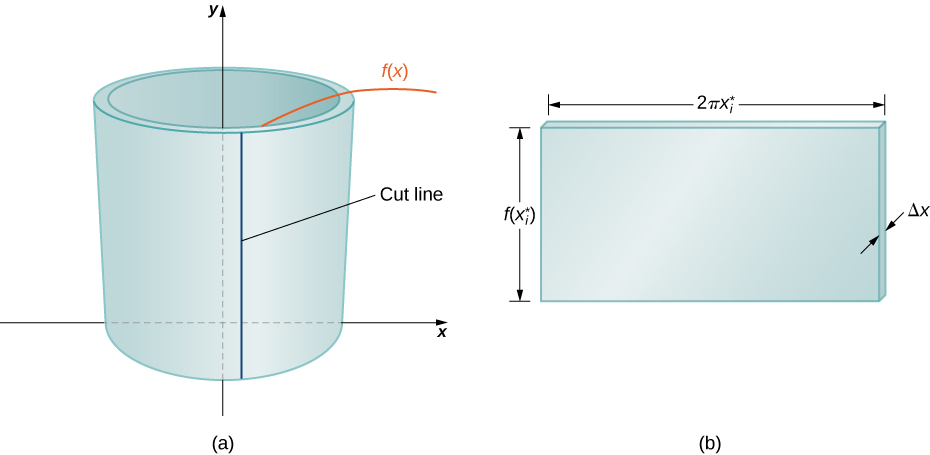
In reality, the outer radius of the shell is greater than the inner radius, and hence the back edge of the plate would be slightly longer than the front edge of the plate. However, we can approximate the flattened shell by a flat plate of height  width
width  and thickness
  ((Figure)). The volume of the shell, then, is approximately the volume of the flat plate. Multiplying the height, width, and depth of the plate, we get

which is the same formula we had before.
To calculate the volume of the entire solid, we then add the volumes of all the shells and obtain

Here we have another Riemann sum, this time for the function  Taking the limit as
  gives us

This leads to the following rule for the method of cylindrical shells.
Now let's consider an example.
The Method of Cylindrical Shells 1
Define  as the region bounded above by the graph of
  and below by the over the interval
 ![\left[1,3\right].](https://opentextbc.ca/calculusv1openstax/wp-content/ql-cache/quicklatex.com-b5552656398377534880dfc998a3bb76_l3.png "Rendered by QuickLaTeX.com") Find the volume of the solid of revolution formed by revolving around the
Find the volume of the solid of revolution formed by revolving around the 
Solution
First we must graph the region and the associated solid of revolution, as shown in the following figure.
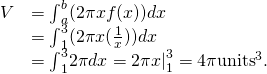
Then the volume of the solid is given by
The Method of Cylindrical Shells 2
Define R as the region bounded above by the graph of  and below by the over the interval
 ![\left[0,2\right].](https://opentextbc.ca/calculusv1openstax/wp-content/ql-cache/quicklatex.com-de42492b70243ee24dda5b2f8df0806f_l3.png "Rendered by QuickLaTeX.com") Find the volume of the solid of revolution formed by revolving around the
Find the volume of the solid of revolution formed by revolving around the
Solution
First graph the region and the associated solid of revolution, as shown in the following figure.
Then the volume of the solid is given by
![\begin{array}{cc}\hfill V& ={\int }_{a}^{b}(2\pi xf(x))dx\hfill \\ & ={\int }_{0}^{2}(2\pi x(2x-{x}^{2}))dx=2\pi {\int }_{0}^{2}(2{x}^{2}-{x}^{3})dx\hfill \\ & ={2\pi \left[\frac{2{x}^{3}}{3}-\frac{{x}^{4}}{4}\right]|}_{0}^{2}=\frac{8\pi }{3}{\text{units}}^{3}\text{.}\hfill \end{array}](https://opentextbc.ca/calculusv1openstax/wp-content/ql-cache/quicklatex.com-b545dcc663fb2d48fc525dc7b018dbac_l3.png "Rendered by QuickLaTeX.com")
As with the disk method and the washer method, we can use the method of cylindrical shells with solids of revolution, revolved around the  when we want to integrate with respect to
  The analogous rule for this type of solid is given here.
The Method of Cylindrical Shells for a Solid Revolved around the -axis
For the next example, we look at a solid of revolution for which the graph of a function is revolved around a line other than one of the two coordinate axes. To set this up, we need to revisit the development of the method of cylindrical shells. Recall that we found the volume of one of the shells to be given by
This was based on a shell with an outer radius of and an inner radius of If, however, we rotate the region around a line other than the  we have a different outer and inner radius. Suppose, for example, that we rotate the region around the line
  where
where  is some positive constant. Then, the outer radius of the shell is
  and the inner radius of the shell is
  Substituting these terms into the expression for volume, we see that when a plane region is rotated around the line the volume of a shell is given by

As before, we notice that is the midpoint of the interval and can be approximated by Then, the approximate volume of the shell is

The remainder of the development proceeds as before, and we see that

We could also rotate the region around other horizontal or vertical lines, such as a vertical line in the right half plane. In each case, the volume formula must be adjusted accordingly. Specifically, the  in the integral must be replaced with an expression representing the radius of a shell. To see how this works, consider the following example.
A Region of Revolution Revolved around a Line
For our final example in this section, let's look at the volume of a solid of revolution for which the region of revolution is bounded by the graphs of two functions.
A Region of Revolution Bounded by the Graphs of Two Functions
Which Method Should We Use?
We have studied several methods for finding the volume of a solid of revolution, but how do we know which method to use? It often comes down to a choice of which integral is easiest to evaluate. (Figure) describes the different approaches for solids of revolution around the  It's up to you to develop the analogous table for solids of revolution around the
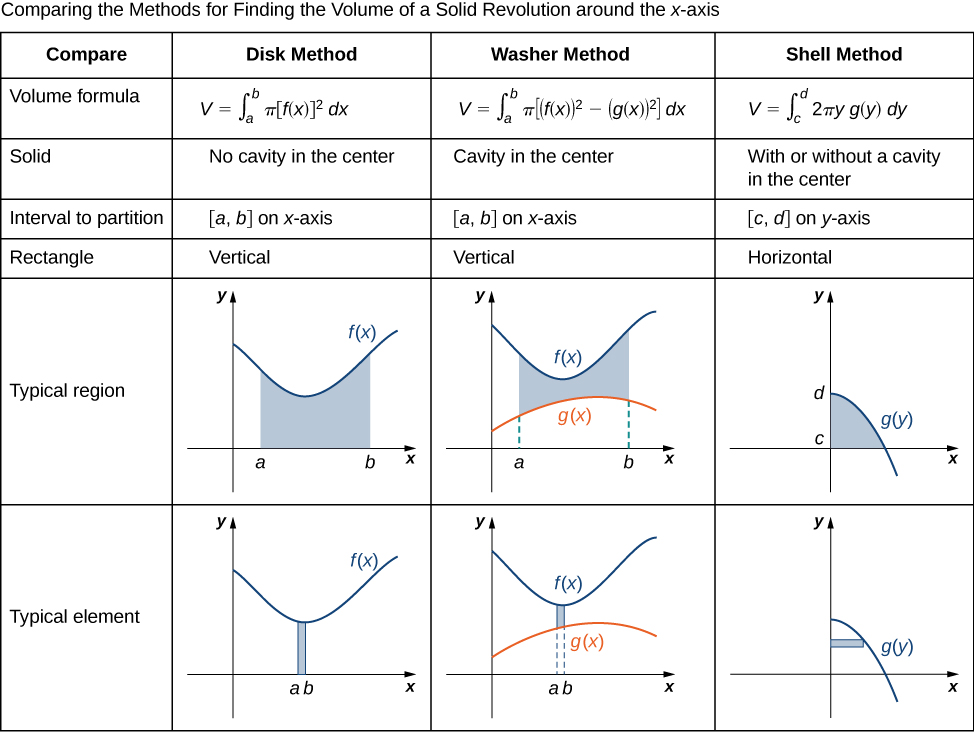
Let's take a look at a couple of additional problems and decide on the best approach to take for solving them.
Selecting the Best Method
Solution
- First, sketch the region and the solid of revolution as shown.
Looking at the region, if we want to integrate with respect to
 we would have to break the integral into two pieces, because we have different functions bounding the region over
 ![\left[0,1\right]](https://opentextbc.ca/calculusv1openstax/wp-content/ql-cache/quicklatex.com-871eb0e2e4c0e4f0bfa1d2134a44da2c_l3.png "Rendered by QuickLaTeX.com") and
and ![\left[1,2\right].](https://opentextbc.ca/calculusv1openstax/wp-content/ql-cache/quicklatex.com-e5437b7a8c15671d00f848f7fe357a33_l3.png "Rendered by QuickLaTeX.com") In this case, using the disk method, we would have
In this case, using the disk method, we would have
If we used the shell method instead, we would use functions of
to represent the curves, producing![\begin{array}{cc}\hfill V& ={\int }_{0}^{1}(2\pi y\left[(2-y)-y\right])dy\hfill \\ & ={\int }_{0}^{1}(2\pi y\left[2-2y\right])dy.\hfill \end{array}](https://opentextbc.ca/calculusv1openstax/wp-content/ql-cache/quicklatex.com-3a39b742050ee44cd54513a34ea8526b_l3.png "Rendered by QuickLaTeX.com")
Neither of these integrals is particularly onerous, but since the shell method requires only one integral, and the integrand requires less simplification, we should probably go with the shell method in this case.
- First, sketch the region and the solid of revolution as shown.
Looking at the region, it would be problematic to define a horizontal rectangle; the region is bounded on the left and right by the same function. Therefore, we can dismiss the method of shells. The solid has no cavity in the middle, so we can use the method of disks. Then

Select the best method to find the volume of a solid of revolution generated by revolving the given region around the and set up the integral to find the volume (do not evaluate the integral): the region bounded by the graphs of  and
and 
Solution
Use the method of washers; ![V={\int }_{-1}^{1}\pi \left[{(2-{x}^{2})}^{2}-{({x}^{2})}^{2}\right]dx](https://opentextbc.ca/calculusv1openstax/wp-content/ql-cache/quicklatex.com-3757d9af1f5a07d3859e17321d45871e_l3.png "Rendered by QuickLaTeX.com")
Key Concepts
- The method of cylindrical shells is another method for using a definite integral to calculate the volume of a solid of revolution. This method is sometimes preferable to either the method of disks or the method of washers because we integrate with respect to the other variable. In some cases, one integral is substantially more complicated than the other.
- The geometry of the functions and the difficulty of the integration are the main factors in deciding which integration method to use.
Key Equations
- Method of Cylindrical Shells

For the following exercise, find the volume generated when the region between the two curves is rotated around the given axis. Use both the shell method and the washer method. Use technology to graph the functions and draw a typical slice by hand.
2. [T] Under the curve of  rotated around the
Solution

 units3
3. [T] Over the curve of  rotated around the
4. [T] Under the curve of rotated around the
Solution

 units3
5. [T] Under the curve of  rotated around the
6. [T] Under the curve of rotated around the
Solution

 units3
For the following exercises, use shells to find the volumes of the given solids. Note that the rotated regions lie between the curve and the and are rotated around the
7. 
8. 
Solution
 units3
9. 
10. 
Solution
 units3
11. 
12. 
Solution
units3
13. 
14. 
Solution
 units3
15. 
16. 
Solution
 units3
For the following exercises, use shells to find the volume generated by rotating the regions between the given curve and  around the
17.
18. 
Solution
 units3
19. 
20. 
Solution
 units3
21. 
22. 
Solution
 units3
23. 
24. 
Solution
 units3
25. 
26. 
Solution
 units3
For the following exercises, find the volume generated when the region between the curves is rotated around the given axis.
27.  rotated around the
28.  rotated around the
Solution
 units3
29.  rotated around the
30. rotated around the line 
Solution
 units3
31.  rotated around the line
32.  rotated around the
Solution
 units3
33. rotated around the line
34.  rotated around the
Solution
 units3
35.  rotated around the line
For the following exercises, use technology to graph the region. Determine which method you think would be easiest to use to calculate the volume generated when the function is rotated around the specified axis. Then, use your chosen method to find the volume.
38. [T]  rotated around the
Solution

 units3
39. [T]  rotated around the
40. [T] rotated around the
Solution

 units3
41. [T]  rotated around the
42. [T] rotated around the
Solution

 units3
44. [T]  rotated around the
Solution

15.9074 units3
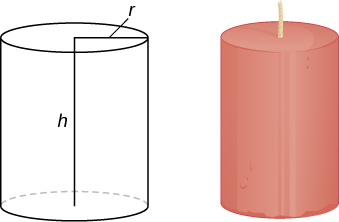
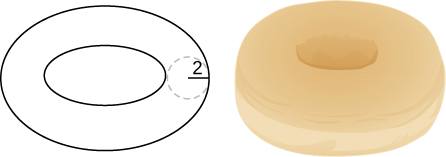
For the following exercises, use the method of shells to approximate the volumes of some common objects, which are pictured in accompanying figures.
45. Use the method of shells to find the volume of a sphere of radius 
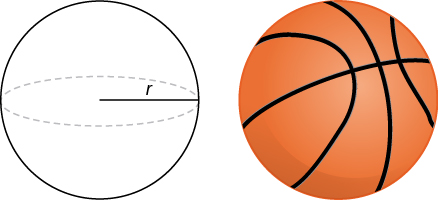
46.Use the method of shells to find the volume of a cone with radius  and height
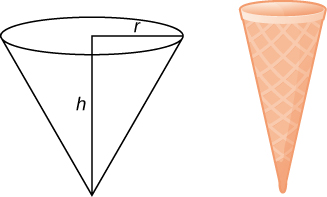
Solution
 units3
47.Use the method of shells to find the volume of an ellipse  rotated around the
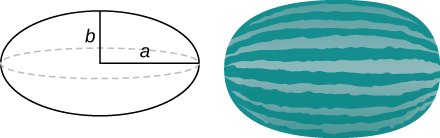
48.Use the method of shells to find the volume of a cylinder with radius and height
Solution
 units3
49.Use the method of shells to find the volume of the donut created when the circle  is rotated around the line
Glossary
- method of cylindrical shells
- a method of calculating the volume of a solid of revolution by dividing the solid into nested cylindrical shells; this method is different from the methods of disks or washers in that we integrate with respect to the opposite variable
How To Find Volume Rotated About Y Axis
Source: https://opentextbc.ca/calculusv1openstax/chapter/volumes-of-revolution-cylindrical-shells/
Posted by: bellsciewher.blogspot.com
0 Response to "How To Find Volume Rotated About Y Axis"
Post a Comment